
I have added a new page to my website! A WRITING page. Two more features to come in the next month or so. Getaway and Men's Health. JAWESOME.
A cautionary tale about vanity
When you are an artist, like I pretend to be when I don't have enough paying work, you often find yourself in the company of other artists. Most of your friends tend to be actual artists of some type or another. Sometimes when this is your situation, one or two of them might ask you if they can paint a portrait of you.
It is difficult not to be flattered by this. It is difficult not to think that there must be something intrinsically worthwhile and transcendentally immortally important about your very being, that has made this person decide that you are worth sharing with others in the world, via Art. That you are like a grecian urn, perhaps, that poets will gaze at, for hours and hours, pondering about Beauty and Truth, and Truth and Beauty and wondering which is which.
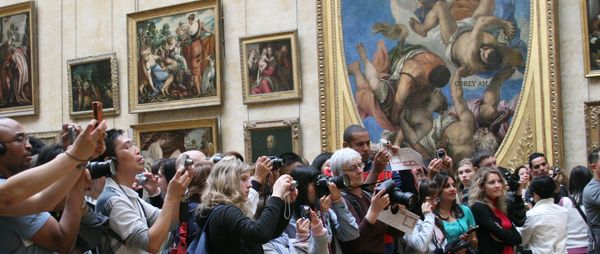
You might imagine, that the portrait of you will become so famous that it will be in the Louvre, beneath one of the pyramids, protected by bullet-proof glass and French guardsmen, ushering through crowds of people with i-phones, one-by-one. That these guardians will stand by you forever, their sole purpose being to protect you from maniacal fans with secret stashes of spray-paint and pipe-bombs. But that even though these guards know you very well because they are always with you, they will never explain you to critics or the general population either. Everyone will constantly be wondering if the glint in your left eye, next to the slightly dilated pupil, pointing a bit to the right means that you are, in fact accessing your right brain (fantasy) which means that you are lying, and/or does this mean that you smiling or not? And what does that mean?
Or you might imagine that the portrait does not actually get sold, on account of all the rich art collectors accidentally crashing their jets into the Alps on the way to the opening. So that you are bequeathed the work by the artist, as a reward for sitting so very still. And you then put it in your attic, where it ages slowly, while downstairs, your real self remains forever fresh and youthful as the years go by, to the perplexment and annoyance of all your friends.
The last time this happened, when I excitedly told John that artist X had asked to paint a portrait of me, he said, "You should say no." I said, "But I have already said yes." So he said, "Well tell X that you have changed your mind." And so I said, "but John this is ART. This is an Oil Painting that will Last Forever. Its not even only Photography, like when G took that photo of L, post breast feeding and it ended up in the National Portrait Gallery." And I might have said, "Do you not think I am worth painting?" and then gone straight to sleep, rebellious and indignant.
And so then you find yourself sitting at a table, in a blue dress, holding a glass of whiskey at a very particular angle. You have applied some caution to the situation, in that you are not naked, having told the artist that your husband said to keep your clothes on. You feel a little awkward, but the artist is saying, "good, that's good" and you feel ok. What you don't realise at the time, is that over the next few months, what you are to become, with the application of painterly daubs, is the Face of Fracking. That soon you will embody Mother Earth, at her most tortured. That you will have been drilled at pneumatically both horizontally and vertically, through all your layers until all the goodness within you has been extracted, and you are left saggy, fractured, bruised and bleeding, and unfortunately completely recognisable. The glass of whiskey will have exploded out with a force of violence so powerful that it lights up the whole scene showing you terrified out of your wits, but at the same time wholly dead and defeated. And you will ask the artist X, again and again, if he is sure that this should be the final version of the painting, rather than a horrid phase of its process.
And then, my dear children, one day, when your husband comes home from work and says, "how was your day?" or actually usually "who did you see at the Glenwood Bakery today?" then you will have to admit that today you saw X at the bakery, and that you also saw a photograph on an i-phone of you as an oil painting. And you realise that you have once again been defeated in the war between optimistic fantastical imaginings and real reality. That the quintessential quality that X recognised in you, was vanity, coupled with delusions of grandeur and a willingness to say "yes" when others, will sensibly say "No, but thank you for asking me, I am very flattered."

Faith47's mural in Durban's Warwick Junction
Anonymous
If one weekend you find yourself packing up a tent in the pouring rain and lightning at 1 am and fleeing from the school camp-out quite drunk and sopping wet, with two small, soaked, cold, disappointed children trailing behind you, it is perfectly understandable that the next weekend you might require to be more anonymous.
If during the week following the camp-out, a parent sees you in the school parking lot and heads straight towards you to say, quite categorically, and probably very accurately, that you were one of only two who left that night, quite drunk and sopping wet – that everyone else made it through; you again, could be excused for seeking out solitude the next weekend, in a different part of the city.
Maybe your NBFF called you a traitor for secretly and hurriedly leaving the camp-out in the middle of the night, while he slept peacefully, dry and calm, through the worst tropical storm in history, thanks to being exhausted from line dancing, having silent pneumonia and finishing the other half of the bottle of Jameson.
Maybe when you got home your husband looked at you with a mixture of horror, pity and I-told-you-not-to-go as you sloped into the house trying to act sober and not that wet with the two sad midgets behind you. If this has happened then you frankly deserve a whole pack of pink tickets to allow yourself to do as many anonymous things as you like.
Perhaps you also admitted to your closest friends that you prepared mentally for the camp-out by going to the gynaecologist for a pap smear the week before so that all activities in the following weeks (possibly months) in comparison, would seem super-awesome. Then you definitely need some time out. Because you don't deserve their puzzled looks and the loneliness you feel when they tell you that this has never occurred to them as a thing to do. Neither has it occurred to them, they say, to drive past a hospital on the way to a school camp-out, so as to put yourself in a relieved, loving and convivial mood, in that the hospital was not your true destination for the evening.
When stuff like this happens I usually take myself to a part of Durban where I feel most safe because no one knows me. I go to where people from my normal residential part of the city say, 'be careful' when you say you are going there. I blatantly take my cellphone to take pictures of the murals and the bridges, and plenty of cash to buy take-away mielies and as many bits of plastic fabric for using at pottery, puri patha and zips as I would like to. There the crowds of people, none of whom I know, will metaphorically say, 'there there, it will be much better next year'.

Working in Khayelitsha is only for uber-cool kids like me and George. Thanks to Violence Prevention through Urban Upgrading (VPUU) for inviting me to do some design work on some of its projects.
Thanks for having me
Some of my happiest nights, not very long ago, were spent in Battersea, on a small broken leather sofa, propped up on one side by a toaster. C and B had me to stay for quite a long time when I first moved to London and had no money and only a few other friends. We liked each other so much we ended up living together for quite a few years. I eventually got my own room, but until then I just closed my eyes very tight when the Scandinavian au pairs came over and when people only wore aprons to bed. That's how well we managed and how well our relationship worked out.
I love staying at other people's houses, and I love it when they come to stay with me. Ask my sister. Sometimes I phone her and say "I have a feeling the dogs next door are going to be way too barky tonight and we won't be able to sleep, so can we come to yours?"
I think a lot about how it would be to stay at some of my friends' houses that I haven't stayed at before. I have sussed out everyone's spare rooms and I have my own private sleepover hospitality rating system. I love it when I go to people's houses for the first time and they say, "And this is the guest room." I think about what kind of emergency reasons I can concoct as to why we need sleep overs. Coming home, late at night, I always think about where I would stay if I had to survive outside on the street. I have a few really good places lined up, just in case my car breaks down coming back from the airport or something like that.
One of my best places to stay is with Brandon and Helen. It doesn't really matter where they are living, I go and find them and stay with them. These are some of the times I have stayed with them:
- In Edinburgh in the kitchen. The house was quite full.
- In Grahamstown under the dining room table. The house was very full on account of the Arts Festival.
- Post muddy festival in Helen's parents' posh Pietermaritzburg Place. Wash the hippie mud off in the sparkly swimming pool. Eat lots of prawns. Drink lots of wine. Watch Deuce Bigalo Male Gigalo on a Massive TV. Turn the air-conditioning in the bedroom to minus five so you can sleep under a duvet in 40 degree heat. Best night ever.
- Durban spare room when John was hospitalised for an unknown terrifying illness and I was scared.
- Cape Town pad. Whenever I can. Last week I went to down to work in Khayelitsha and of course I stayed with them. I deliberately didn't make my bed; made my hair clog up the shower and left snotty tissues everywhere – to test their hospitality and our friendship. They didn't mind. What good friends.
I think my mother started it. We always had people in our house when I was growing up, and we made their rooms nice, and put little bunches of flowers next to their beds. I do this when people come and stay at our house, in the downstairs room. Or maybe it was my granny. She had a pink room and a blue room for guests, with suitable super-fluffy eiderdowns and many empty drawers and crocheted clothes hangers. Of course I do like my own house, but it goes with so much responsibility, and it doesn't go with a Holiday Feeling.
Maybe one day I will grow up and stop living in other people's imaginary spare rooms, but for now, I reckon there are worse fantasies to have. So thanks everyone who has put me up and up with me so far. Thank you Brandon and Helen for having me last week. I am excited to have new Cape Town work. To the rest, if I've drunk too much at your dinner party, its doubtful I will go home. Uber never seems to work on my phone.

dear Jess
Dear Jess,
I was very disappointed when I found out on Facebook that you had been dissing me in your blog. It was a shock that an experienced journalist such as yourself, did not take the time to fact check, and relied on gossipy rags for your information. Of course I was not in love with Natalie on account of her emails. Did you not see the photographs she sent? Did you not watch Black Swan? Or how about Closer? I bet you don't even know cochon d’inde is French for guinea pig, because you are only one-sixteenth French and she is a lot more.
And with regard to the guinea pigs, I was sad that you had chosen this quote to reference. You yourself have rabbits. You know how difficult it is to care for them. You had 17 at one point. Do you not understand Wonder? Yesterday we saw five bunnies when we left the community pool, and they didn’t clear my Wonder Line, but the look in my son’s eyes definitely did. He also made prolonged eye contact with a horse, during which it was pretty clear they were having some sort of communication. That made me feel wonder.
Also Natalie's ex-boyfriend described her as Moscow, and in your blog about touching stuff, John says you looked rather Russian, so I thought you would like that you and Natalie have that in common.
Anyway, please can you not do that again. It was very hurtful.
Regards
Jonathan (S.F)
PS. The New York Times did do a fantastic job of the layout of the story don't you think? I bet that is why you are so cross. Also you have to admit that you wished so much you had found a die-cutter in Durban to make you Tree of Codes, but I got there first. Ha. Did I tell you that it won an award. For Book Design. Your Game Supposedly. So There.
Foxes versus Monkeys
Making decisions is very difficult. Take for example Jonathan Safran Foer making the very big decision to leave his wife for Natalie Portman. He did this without actually checking to see if Natalie thought this was a good idea, or in fact wanted anything to do with him IRL, or was at all in love with him. His decision was largely based on partaking – for a very long time – in the most pretentious and embarrassing email relationship the world has ever had the misfortune to have available on the interweb.
'It’s almost 6:00 in the morning. The boys are still asleep. I can hear the guinea pigs stirring, but that might be the residue of a nightmare. People often refer to aloneness and writer’s block as the two great challenges of being a novelist. In fact, the hardest part is having to care for guinea pigs.'
I can understand falling in love with someone based on their emails to you. Even just their text messages are usually enough for me. But you have to check with them before you leave your husband. If say, you have been listening to True Love Waits, and then someone buys you a packet of crisps and a lollipop, this does not necessarily mean they are in love with you. It could be inadvertent. They could maybe not have ever even listened to the song. Foer did not take this into account enough when trying to extract the subtext from Portman's embarrassing main text.
Britain had to make a big decision recently, and chose to do this by referendum. This was very silly. Many people are uninformed and irrational (to be polite about it). Often I decide I would like to go and live somewhere else. I usually decide I would like to go back to England, and live in London. The Brexit decision, however bad the methodology, has helped me a little, because I, along with many other foreigners, skilled or unskilled, are now thinking about crossing England off their lists of places to go and live in. All over the world, good and useful people who might have gone to live in England are reconsidering. Their lists of '...but on the Plus Side...' and 'on the Minus Side' are being altered.
Making plus and minus lists are what rational people have always urged me to do, when making decisions. They say, "You can't think about say, the question: 'Would I prefer to cuddle up to Boris or Jacob, or even Theresa?' You can't try to see into the future. You don't understand economics very well, nor politics. You can't rely on all the foreigners living in Durban saying, 'this is Paradise, I don't ever want to leave', because they can always go back to their R24 zillion bachelor flats in Clerkenwell." They say, "You have to think rationally and properly about what it will be like to live in that place every day."
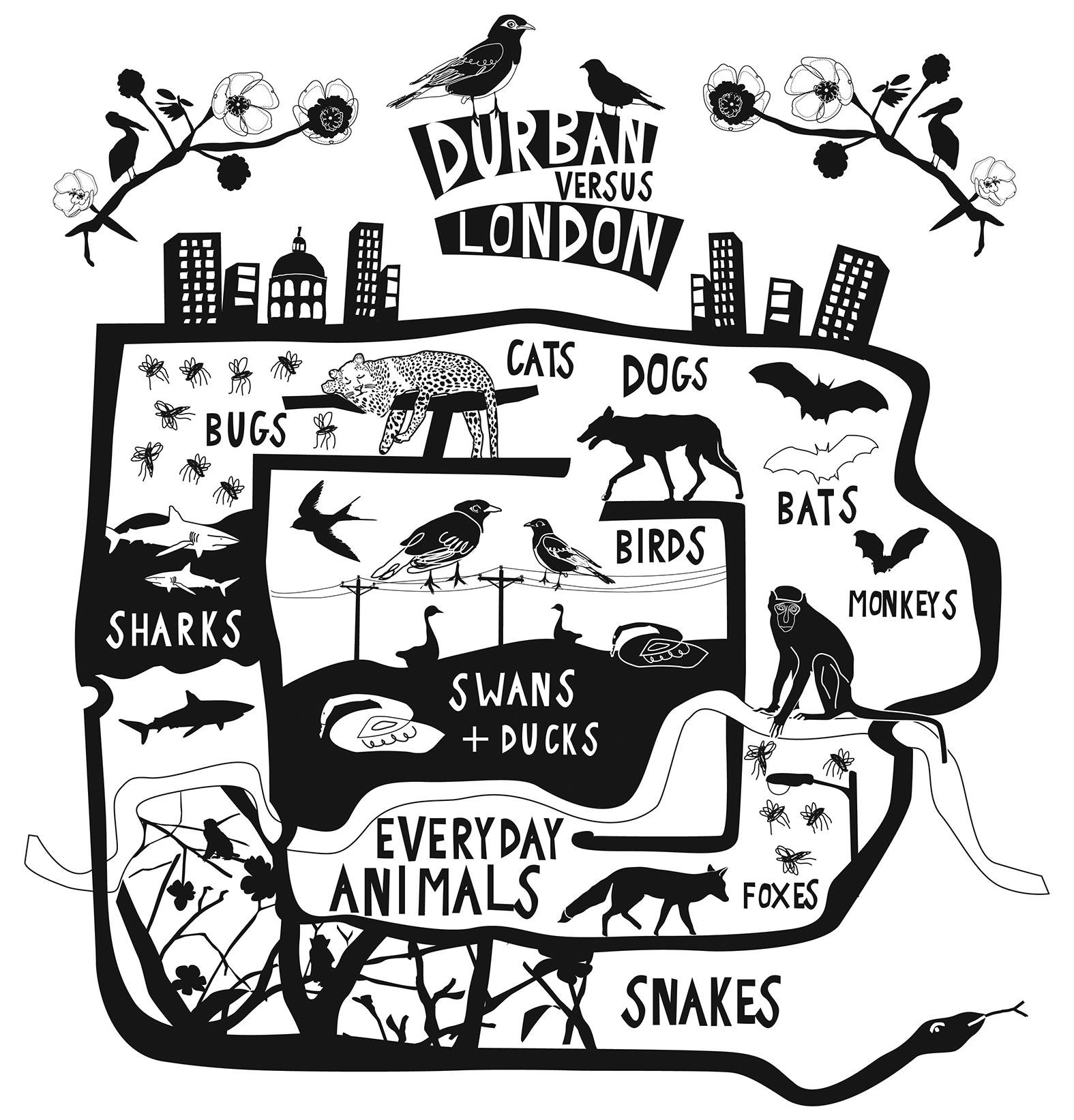
So sometimes I listen to them, and I compare, very neatly and rationally, the every day experiences I would have in each place, to help me decide. Every day experiences though, are very complex. So if you are going to use this method, you have to divide the main topic into subtopics. So say, for today, we choose the topic of Animals I Would See Every Day. Then tomorrow, we can choose, People I See in Coffee Shops Every Day. Choosing Animals I Would See Every Day, is partly inspired by Foer's reference to guinea pigs in his emails, but only partly.
Every Day Animals
1. Snakes
You might say it is not fair to include snakes, because I do not see snakes every day in Durban. This is true. But I know there are snakes in my garden. There has even been a snake in my laundry cupboard and in my kitchen. There has been a python snuggling up to a goat in my electrician's car parked outside my house while he fixed my plug points. So snakes can be counted. I really hate snakes. I would never ever touch one. So you would think London (no snakes) gets the point, but this is a complex game. Snakes are hilarious in that they give you a fright. Watching someone get a fright is brilliant and thinking about them getting a fright can cheer you up for days. I know, for example, there is a snake living in the tree just where our gate is. I know this because sometimes the dogs run along next to this tree causing it to wobble and the snake to fall out. Once, under these conditions, the snake has fallen on me, and I did get a huge fright, and once it fell on a nine-year old child. Luckily this child was wearing a wide-brimmed cricket hat. The memory of this is a treasure to me. And one could make a really popular Vlog about it and become a YouTube zillionaire.
2. Cats
Much of a muchness really. Except: you do get genet cats in Durban. They live just up the road. I have seen one walking in the courtyard, right here. There are leopards about. Robynne and I thought we saw a leopard the other day while on a casual stroll in the mountains. We decided to creep until we were 'downwind'. It turned out to be a wildebeest and didn't mean us any harm. Domestically, cats in England win, because they keep you warm in winter.
3. Ducks and Swans
This holiday Al said he was very upset because he saw a duck rape in Kimberley. He said the raping duck was holding the head and beak of the other duck under the water for a very long time, and it wasn't very nice. South Africa has the highest rape statistics in the world. I'm not sure of the statistics on ducks, but no one has ever told me about witnessing so terrible a scene in England. I love swans, but all swans in England belong to the Queen.
4. Dogs
Many South African dogs are scary. Many are racist. My daughter and my sister and at least five of my friends have been bitten by dogs, just out on casual strolls around the neighbourhood. Pitbulls are banned in England and are not banned in South Africa. People here regard them as 'misunderstood'. The only bad thing about dogs in London is many owners force them to wear crocheted jackets in the park.
5. Sharks
Refer to the paragraph above on snakes. You know they are there. They could give you a fright. Does this spoil or enhance the enjoyment of your every day evening swim in the warm, soothing Indian Ocean or should London get the point? Oh wait a minute...
6. Hedgehogs (and other Beatrix Potter creatures) versus Porcupines
Both are very cute as youngsters. Porcupines are more dangerous on account of their very spiky quills, but then again, quills are very useful for poking bored and moaning children, and keeping them occupied on long hikes; and also useful in ceramics classes for making textures and holes.
7. Insects
Do you prefer the sound of traffic, or the sound of buzzing and chirping? Neither places are silent, you can forget about that. Remember if you choose buzzing and chirping as your daily lullaby, you might also get biting and itching.
6. Monkeys versus Foxes
Monkeys are hilarious and totally my favourite every day animal in Durban, even though they steal my bananas and the toothpaste all the time. But I also love foxes very much, especially the ones in London. Its always such a nice surprise to see one. A good fright. They are the underbelly. I also love snow.
BUT I have found Londoners on the whole don't like foxes and they get annoyed when it snows. So would I manage to re-integrate after a decade of being away? I am not sure.
Has this been a useful exercise? No. Is there a good way to make a decision? No. When I told John about my idea for this blog, he didn't say a word. He just shook his head and carried on reading the newspaper. Should I have listened to him? Yes.


Happy Endings
Thea and I like to touch things. I've learned to constrain myself to socially acceptable practises and avoid mud until Tuesday nights: pottery nights. Thea can't help but put her hands in the dirt. She always picks stuff up even when I yell at her and beg her not too. Then she wipes her face. She twirls her hair into tight knots and brushes the top over these bits so I can't tell. She cracks the 50 metres of bubblewrap I always have. She puts her fingers inside the strings of tennis rackets All The Time. She put her fingers in the cake batter. Of course she has licked dry ice.
When we go shopping we always put our hands on all the dresses as we move along. We run our fingers along railings. We fondle the petals of roses. Every day we turn rabbits upside down to access their soft soft soft bellies. We phone up Greg and beg for Henri to come over so we can touch his beagle ears. Thea will not sleep with fewer than five of the softest tigers. Keep your mohair jerseys away from us. We will stroke the inside of your jacket secretly while you fall asleep next to us at the movies.
My sister is the same, she had a blanket as a baby with a silk edge, that my mum constantly had to replace – worn out with stroking. She still does it. She holds on to the arm of the waiter with the silk shirt on, without even realising it, while we choose our dinners.
Luckily, John is the also the same. He doesn't mind being touched by people or them touching him. People he knows, mostly, I think. He says our neighbour Rico gives the best massages, even of the earlobes.
Nina is the same. She recently shared On Facebook a shout out for platonic intimacy. "Kiss your friends' faces more", it said. It meant their Real Faces. It got So Many Likes. At dinner on Friday we were talking about a question we could ask someone we didn't know, who we met at a party, that would elicit the most information possible, in one go. Nothing really satisfactory came of this discussion except, if they were to be your lover, look at the hands. Obvs.
So, of course, when Nina said she would henna my and Thea's hair on Saturday we were excited. We'd seen Rachel and Sophia's hair that very day. We wanted the same. But we also know Nina's hands. Long and slender with matt black nails. We know she has been to the Sudan. We know she knows about henna and she knows about dukhan. When you go to Nina's house, real owls hoot at you. There is a deck that looks out over the trees inland. The sun shines into the house, just where you sit while she puts mud onto your head with her most beautiful fingers.
Of course you can also talk while your friend fiddles with your hair, like the women of the Sudan and Ethiopia do. You can work out all your problems. Fleeting anxieties like, "will she find a louse?" pass quickly away under these conditions. Vague insecurities, like "will my daughter and I turn wholly orange because we've left this in for such a very long time, and will we ever return to normal before school starts" are replaced with "who cares" because having this person touch my head for this afternoon is Amazing.
And when eventually you agree to go home, you get there and say, "look John I finally look like the goddess Nastassja Aglaia Kinski". And John says, "Yes you do, my love. Wow you look very Irish. Actually you look quite Russian" (because you have interrupted him reading a short story by Pushkin which involves "pistols at dawn" but with swords). And everyone is satisfied. More than satisfied. Dare I say, in fact, that the story about people who touch things, their new red hair and black finger nails always has to have A Happy Ending. Thank you Nina!
Running
Usually I go running by myself and sometimes I go running with K. Usually when I tell people I go running looks of disbelief befall their faces. Women ask me if it is safe to run alone in Glenwood. Until this week I have always answered, "Yes it is, I have been running in Glenwood for 15 years and nothing bad has ever happened to me." I say, "sometimes if it is dark and I need to run, I take my dog, Lucky." I say, "my sister-in-law usually runs with a fork." And we all laugh, ha ha ha ha ha.
I tell them the story about when a man decided to run with me for some of the way, and although I was initially suspicious and not keen, there was nothing I could really do about it. I was actually grateful because when we got around a corner we faced a crowd of people seeming angry and singing Umshini wami. But no one brought them any machine guns, and the man eventually found my pace slow, and said goodbye lady, see you later.
I tell them that when I have got into bad situations where I have been scared of men, it has been of men that I know, and that the statistics support this. I tell them I have demons in my head and running helps me fight them. I seem to have a malfunctioning hippocampus, I say, that needs to be regulated. I am confused about what I am thinking quite a bit of the time.
I tell them about my forefathers and mothers most of whom were not strangers to institutions for the insane, or who have walked into the mountains forever, shot themselves, died of broken hearts. We must be careful in my family, and not neglect to run. You will find the same thing in your own families. You should run. Sometimes I need to be so tired in the day after running that I don't think about bad things, like Brexit. Sometimes its like the relief of putting your hand inside boiling water to get perspective when you feel you have done much more washing up and making school lunches than anyone else in the whole world.
When I run with K, we have the best time. We run faster because K has Long Legs. We tell each other things that we don't ever tell anyone else. Our secret crushes, our mistakes, our elaborate plans to save ourselves in the end. And we talk about how we are not ever afraid running around Glenwood.
We wonder together whether we are running in order to have better bodies and thinner thighs and wedding day arms and whether we are doing this for ourselves or for the ones that look at us. I tell K that she is a goddess and I wish I was her. She tells me about her aunts and cousins and friends and how they always notice if you have lost or gained 500g. I tell her that I am always in two minds about looking pretty, that even a necklace makes me feels too showy. She says, come on Jess, be more showy, be more flaunty. I would love to, I say, but I have reservations.
This week on my run, I stopped, because I was tired. Stupidly I stopped just where there was a man. And he called me over to tell me something which I could not hear. Stupidly I moved closer. Stupidly I was polite. Suddenly I was in a bad situation. I didn't have K, I didn't have a fork. I didn't have a dog. I pushed this man away with all my might and then I ran as fast as I could.
We went to watch the African Championships Athletics this weekend, to see the runners qualifying for the Olympics. I saw these incredible women sprinting their legs off. I saw Caster Semenye get three gold medals. I thought, I want to be like them. I want Caster's legs and the forearms of a shotputter. If I was them, I thought, there is no way I would ever have to stop on a run around Glenwood. There is no way anyone would ever catch me. I would have no boobs left, and lose my softness, but that would be a bonus. I give up the dream of less thigh and skinny wedding day arms, now I want more. More Muscles. 1000 lunges an hour and the hugest legs ever, to run and kick and stamp with. I wouldn't need a fork or a dog. Run even more, I reckon, do lots of squats.
the best morning because it involved talking
John says I wouldn't last 15 minutes at a 10 day silent retreat. He is wrong. But there is nothing really better than talking to someone kiff. I can't really do another post this week, because that would just be saying too much. But I can say more, by using someone else to say it. I had a lovely morning talking to my sister and Elda at the Bakery for quite a few hours. We talked a bit about Rosa and her writing. Rosa has written very well about talking and falling in love, and many many other topics. This is my favourite essay about talking EVER. For more go to rosalyster.com
Essay 9: The Language of Love
Here is a young man on the verge of adulthood. White, educated, adrift. First person narrator. He is usually between the wars, but he doesn’t have to be. We can find him contemporary novels without even trying. His name is Charles or Henry, or at the very least, Michael or Nicholas. Never Mike, never Nick. If he has to be a Catholic for some structural or atmospheric reason, his name is Patrick.
We are given to understand that he is clever. He has a severe father, also clever. The mother is not what you would call Book Smart, but we see that she has a certain something. She is still the most glamorous woman the narrator knows. Her legs are honed from many years of tennis playing. She was a celebrated debutante and had the choice of the finest men in the city (“my mother’s beauty was a thing that happened to her, and it governed every decision she made”). Most of those fine men are then eliminated from the running (wars, madness, they die of the flu, money troubles), and so the mother had to settle for the severe father. The severe father is devoted to his wife (“my father was the most uxorious man I have ever known”), who accepts his attentions with a kittenish good humour. We are given to understand that they still have sex all the time. The father is always getting his hand up the mother’s jumper.
The narrator has no siblings. He has had one relationship with a girl he found tiresome. She read either too many books, or not enough, or else they were just the wrong kind of books. She is shrilly political, or else she is discarding all sections of the newspaper except Property. She is either too serious, or not serious enough. Her laugh is somehow wrong. There is sometimes a bead of moisture hanging off the end of her nose, and the narrator is always looking at it and wishing that he was dead. She has lipstick on her teeth, or else she is playing the cello in a way that speaks of a terrifying morbid sexuality. She is either a cutter, or else has never had a day’s trouble in her life and is oblivious to the suffering of everyone around her. She tires the narrator out with all of this, but the main thing with her is that she talks too much. She talks about everything, all the time. It is all the narrator can do not to get her into a lake and drown her so that it looks like an accident. He consoles himself with dumping her in a way that seems astonishingly cruel. The bead of moisture at the end of her nose wobbles as she cries and, finally, falls onto the fabric of her dress. The dress is the wrong colour.
The narrator is waiting for something, but he doesn’t know what it is. I do, though. I know fucking exactly what. It is a strange, silent relationship with an older woman. Get ready, young narrator. Here comes your sexual and emotional reckoning, and not a moment too soon.
They met at a pre-war garden party, or on the deck of an ocean liner. It was just the two of them and the spray of the sea air. Inside, a whole party where everyone is drinking and waltzing across the waxed ballroom floor. The floor under the dancers’ feet rocks with the movement of the waves in a way that is like to make you vomit, but the dancers do not mind. They are too busy talking, talking, talking. About? Nothing, of course. We are reminded of the tiresome first girlfriend. The older woman is married to a callous bon vivant who doesn’t love her, and the young man knows all this without having to ask. The best thing about the older woman, in fact, is that she doesn’t want him to ask. She puts her elegant hand over his mouth, in fact, and says, “Don’t speak, please.”
The young man is always going to the house of the older woman and she is Wordlessly opening the door for him. She is just standing there in a silk dressing gown with an unreadable expression on her face. They don’t talk and the man can’t even read her face, but they have an understanding which surpasses speech. This extends to a tacit agreement that talking is for the weak. They are making ferocious love in every part of the house. The older woman is wearing suspenders and you will not believe the calm compassion with which she guides him inside of her. Still no talking, ever. He is in love with her bony articulated shins, the shining diamonds of her kneecaps.
Their relationship runs its course. They mutually agree, without speaking, that to everything there is a season. No talking. They go their separate ways, and the narrator hears nothing of the older woman for many years. In the second to last chapter, we find out that she has killed herself. Pills.
I made up this particular book, but there are plenty of real ones to choose from. Even if a writer doesn’t embrace the narrative arc in its entirety, he picks out certain elements of it. The older woman doesn’t have to die at the end, but she does have to be quiet a lot, or at least speak only when there is absolutely something to say. The young man doesn’t have to have a sexual mother, or even be young, but he does need to pine for silence. He does need to despise idle chatter. There does need to be at least one scene where the narrator describes people talking by using a descriptor like “braying’, “screeching’, “howling”, “talking avidly without sense or mercy”. Both Amises have done this, as well as Evelyn Waugh, Edward St. Aubyn, Joyce, Nabokov, Updike, Coetzee, Richard Ford, and Lawrence. There are definitely others.
It is important to say now that I love some of these writers. So much so that I can put aside all the weird stuff about women, as well as the occasional creepiness about money and class. I just pretend it’s not happening. I skip over the worst bits and then google “Evelyn Waugh did he get divorced”, and I am satisfied. I can forgive, also, their idea that there is such a thing as being Too Intelligent. I am fine with all of that.
Really, it’s just the talking thing that gets me. It is the one thing I cannot excuse. What is all this about hating the sound of the human voice at full cry? Why are all of these characters so thirsty for quiet? Why don’t they ask each other any questions at all? Why do they pretend that you can know someone even slightly without talking to them for a long time? What is this nonsense about the language of love being anything other than words? When people in real life stare wordlessly at each other, it’s not because they are grooving on a telepathic level. It’s because they are boring, or on drugs, or scared.
I have never fallen in love with a person for any other reason than the way they talked. Talking, for me, is what does the trick. What they said, and how they said it, and then how they made me laugh. What else is there? Talking is what separates us from the higher primates, and we should all be heedful of that.
I want to read a book where the older woman asks the younger man a whole lot of questions. She is not shrewish, or shrill, or strident. She just has a few things she would like to know. She asks him, for instance, what his problem is. She makes him explain why he thinks he is smart. She asks him why he thinks it’s fine to wear that shirt with a Nehru collar. His answers are unsatisfactory, and he leaves. She goes out for dinner with her best friend, and the two of them talk until their whole faces hurt.
four trillion reasons to hate boats
OF COURSE THE MAIN REASON: you can't get off and leave whenever you want to.
Especially a problem when, as I have done TWICE (repeat your mistakes) you agree to go to a party that is called a booze cruise, sometimes called a booze cruize.
You should know straight away that this is not right. You should know in advance that it will be boring and the music will be terrible, and you won't be able to get off and go home whenever you want to. There are no french exits on boats, nor is there any ghosting. The only getting off will be with other people's boyfriends, because you don't have one of your own. I absolutely know that this is not a good idea. Nothing good ever came from it. Not even having a laugh, came from it.
Another time you agree to go to a party called a booze cruise, because you feel you have to. And you feel you have to dress to the tropical island theme demanded on the invitation; AND OF COURSE nobody else feels they have to. Perhaps one other person wears one hibiscus necklace, another maybe a pair of jolly trousers. But nobody else wears coconut husks and a grass skirt because nobody else feels quite as compelled to please the host. Nobody else believes it to be their very own responsibility and duty to make the party WORK OUT. Nobody else exhausts themselves with talking more nonsense than has ever been possible, because no one else has quite the same terror of awkward silences on boats. Not at all.
OF COURSE THE SECOND MAIN REASON: vomiting
You don't only vomit when you are on the boat, but you vomit when you are looking for your flip-flops which you put in the supposedly water-tight cubby hole, so that you can walk on the boiling hot sand when you get out of the boat. When you open up the cubby hole after going paddling you realise that this place has never really been free of water; and one of your flip-flops has floated down to the middle of the under-section of the boat and you cannot get it out. Putting your head in to try and see where it is stuck makes you vomit because the water in the supposed-to-be-dry part of the boat is disgusting.
THIRD MAIN REASON: you have to go to the DUC
If you want to go kayaking in Durban you have to hire a kayak at the Durban Undersea Club. If you are not a member of the DUC this is very tiresome. You will eventually be granted the exceptional right to go on a boat on a Sunday (a day reserved for only members to hire boats, although no one does because one of the main reasons to become a member is because you want somewhere to stash YOUR OWN BOAT. ) If you are not a member of the DUC you cannot go to the toilet or buy any drinks, not even water. Getting other people to buy you drinks isn't too hard, in fact I like that, but asking strangers to help you go to the toilet is demeaning and horrible.
4. Going to the DUC makes you feel like you are still living in Apartheid.
5. Going to the DUC reminds you how much you hate jet-skis; water-skiers and people on motor-boats, especially people on motor-boats at Port Edward.
6. If you go on a sailing boat you trip over all the piles and piles of ropes that are constantly getting all tangled up. You are in a lot of danger in that you may at any moment be struck off the sailing boat by the sail itself.
7. You know someone who offers to take you on a trip on their boat. This doesn't feel at all right to you and you don't want to, but you don't have the toughness or power to say no thank you, because you are still a child.
8. You know someone who was a journalist for the Rand Daily Mail during Apartheid, although usually most of his sentences were blocked out with black marker pens by the government. In his spare time he makes himself a yacht. It takes 20 years. Then when he goes off to Singapore to buy the sails, the last thing he needs to do, the Special Branch burn it down. Nothing is left. So he moves to Australia forever.
9. Horizontal navy blue stripes are not slimming.
10. So many many more reasons. When I am stuck for something to write about I will revisit this issue easily. For now, I do just want to state that Rafts are not the same as boats. Rafts are for people stuck without boats, so they are fine. In case Georgie reads this.
happy birthday my mum
How hilarious is this picture of my sister? This was taken forty years ago, when my mum was 30.
When we were growing up my mother did everything she could to prevent us from being in Apartheid. My father has always been in the public eye, but it was my mum who taught him about what was really going on. They got into trouble, and their friends were murdered and banned, and some were never to leave their houses, and my father was on a hit-list. But my mother guided us bravely and seemingly effortlessly through these years.
She fought the government, she got old people pensions, she educated the unions and kept everyone schooled in the rules of English grammar. She didn't flinch when the police came to arrest us for watching cricket, or when tonnes of toilet paper was delivered to a Black Sash and ECC meeting at the Diakonia Centre, just to freak us out. I was freaking out, but she kept calm.
All the while she kept us safe and loved, taught us manners and how to wear halter-necks. We learned how to be good swimmers and play tennis. We did horse-riding, played the piano and the violin. We climbed the mountains to the very top, we went to Malawi and Zimbabwe. She took us out of school and we travelled around Europe. She explained to us about being Irish. We went to England for a while. Our life in South Africa was cushy safe suburbia, but there were always a couple of stowaways in the garden cottage.
We were naughty and got into our own kinds of trouble, but we knew she had our backs. When my sister rode her bicycle into a car and had to be in Addington hospital for two months while her leg repaired, she went to see her everyday, sometimes twice. Once our windscreen wipers weren't working and it was raining so hard we couldn't see our way to the hospital, but undeterred, she showed me how to wipe the glass with raw potatoes so we could get there. Another time, my sister was very sad, so we smuggled kittens into her ward under our jumpers. We took charming men along to distract the nurses and give them champagne.
And when I did the worst thing ever, which was to put my head under a bus and get it run over, my mother did not freak out, well not in front of me. She washed the blood out of my hair and put it into plaits so I might look a bit prettier, a little less squashed.
At 70, she still does all this. When Jack broke his arm at the game reserve and I tried to wrap it up with what turned out to be an eye-patch, she bandaged it practically and properly, but in a kind way, without snorting at me. The children of Chesterville and Cato Manor understand Macbeth thanks to her. They understand Yeats and Keats and can write in rhyming couplets. You can say any line from any poem in the whole world like "You who are bent, and bald, and blind..." and she will tell you what it is and say the rest of it. She gives interviews and goes on marches. She travels and writes and looks after us all. How lucky I am.
The perspective hospital
I missed the Russian athletes at the Comrades Marathon yesterday. I had been thinking about them in the run up (sorry) because of the current debate in our household as to whether to download War and Peace, the series, or finally actually read it. I have always wondered why so many Russian runners enter this race, whether it has anything to do with it being called the Comrades Marathon (even though it doesn't have an apostrophe). And I really like the twins, Elena and Olesya, who usually win.
I think about twins a lot and when I see these two running together with torsos and ponytails jumping in exactly the same way, I am fascinated. Do they decide beforehand who will win that year, and take turns? Is that match-fixing? Do they secretly actually use banned performance enhancing substances? I've watched them pretty carefully when they are on telly and I've never seen them dart off for a quick blood transfusion in a van, like the cyclists in the Tour de France. They claim it is unfair they have been banned this year, but are looking on the bright side. According to a newspaper interview, they see it as an opportunity for a holiday; to spend some time with their parents and do a bit of farming.
Is this stoic and positive attitude in the face of such disappointment and hardship, a particularly Russian characteristic? Or perhaps the characteristic of an ultra-human who has pushed them self (and their other self, running next to them) to their physical limits? More importantly, how deep does the sibling rivalry run? So do they encourage or discourage one another along the way? How do they deal with the victory for one, and not for the other? Does anyone even know who is who, and therefore it doesn't matter who wins? But nevertheless, what is the best thing to say to each of them afterwards?
I was discussing this problem with Al, who ran the race yesterday. He said his worst is when you don't do as well as you intend to and then you have to endure kind eyes from your friends and obvious encouraging phrases, like "at least you tried" or "there is always next year" or "you are lucky you could run, I had to drive from 'Maritzburg and it was such a hassle with all the roads being closed." Even someone saying "well I think you're amazing," when you yourself know you are not amazing, doesn't help. So I asked him what I should say, should this situation occur.
He told me about when he ran the Sky Run the first time and how he cried along the way, because it was so hard and he was very lonely. He told me about a friend of his who was running a marathon and was also crying a bit and feeling lonely. Then a beautiful young woman came along and tried to encourage him, by running alongside him and chatting in a motivational way. This wasn't helping. The exhausted man just kept saying stuff like, "I can't make it" and "I am too tired and useless" again and again. Eventually the woman gave up and went ahead. After a few minutes, she stopped and ran back to him. Then she said, right in his ear "Just Man the Fuck Up". Al said that this is what I should say.
Perhaps Elena and Oleysa say this to each other along the way to make sure they get there in time. Or maybe Caroline Wostmann said it to herself yesterday as her legs buckled uncontrollably under her for the third time, and Charne sprinted past her without even a small sorry-about-this tap on the shoulder.
I admit a small tendency to be self-pitying, and usually it only helps a little to seek out someone who will look at you with sad eyes and offer words of tender solace. What generally works better is when someone from my inner circle says "Oh for God's Sake" or "Just Man the Fuck Up."
Another option is to go on a road trip to the Perspective Hospital. This is a place near Eshowe otherwise known as the Hospital for Incurables. This is the saddest place on Earth, a place anyone with any ounce of self-pity should visit. It was a visit to this place that John threatened the children and I with last Christmas, but in the end we were spared. You only have to go once. The sad irony, of course being, that you will then be cured of your noxious self-inflicted mental disease, while the 'incurable' will be left not at all cured. Only slightly cheered by gifts of books and toiletries.
Or else, if you can't get to the Perspective Hospital, you could watch the Comrades Marathon just as the man is about to shoot the gun to hale The End, like John and the children did yesterday, until I yelled at them to switch it off. You can watch people crawling and weeping and pulling each other across the finish line, only to just miss getting a medal by a millisecond. I stopped them watching because we had already seen people at the finish face down on stretchers, being taken to the Real Hospital, not the Perspective one. But apart from at 5.25pm, I really love watching the Comrades Marathon. It was especially good yesterday when Ludwick Mamabolo did a small dance at the end, perhaps in praise of David Gatebe, the record-breaking winner. And thankfully Al who wanted to be in the Top 100, came 98th. So all we had to do was ply him with sincere congratulations.

XENOPHILIA
The reason Parisians do not like tourists is not because they speak French badly, but because they dress badly. Dressing badly makes their city look less amazing, and is offensive and annoying to the beautiful French people. It is not acceptable to nip down to the patisserie for a pain au chocolat in your tracky bottoms. I can understand this, and I know this because of a book I read about an Australian who lived in Paris.
It is not the same in Durban. In Durban people wear flip-flops, if they even bother to put shoes on, and I have seen people walk into the Bakery with wet pants on and sand in their hair. They think they can look hot by putting a surfboard under their arm. Mostly they kind of can. It is lucky that I currently live here, because about fifteen-sixteenths of the time I am too lazy to decorate cities.
But I am one-sixteenth French, and at least one-sixteenth of the time I decide to exercise and promote my minimal, but over-stated Frenchness by wearing infinity dresses to neighbours’ braais and chastise everyone else for being so sloppy and disrespectful to the hosts.
In Durban, unlike in Paris, foreign visitors and residents actually raise the sartorial standards. Among many other standards.
The first time I met Al, who is English, and therefore a little bit foreign, he was wearing a bright beaded necklace – and other clothes and accessories of course – and he helped me save a stranger’s rabbit on Shirley road. We chased it from opposite directions into the rabbit owner’s garage and then we went away.
I found him again about a year later at the Bakery eating a pain au raisin (although I am not sure what percentage French he is) and we became friends. And I became friends with his wife, Georgie. He was still wearing his necklace. He told me his son made the necklace for him at preschool and he hasn’t taken it off for years. This is great. Its like when my daughter made Joe a shell necklace for his birthday and he wore it for months until the bits of shell were breaking off while he slept and poking him too much and he had to take it off. Him wearing it made my daughter very happy, but it probably isn’t really very French.
Last year my now friends had a party to celebrate their wedding anniversary. It was a xenophile party. We all dressed up and were keen and relieved to celebrate foreigness after the recent xenophobic attacks. Last Saturday we went out again, for Al’s birthday. We all dressed up. Above this text is a picture of the inside of Al's jacket.
We had our normal conversations about how to make money out of the 6000 grams of excess chicken fat one small Woolworths food shop produces every day; about our children and the difficult questions they ask us: “If lightning and cement were to have a fight who would win?” and “does it take longer to make a cup of tea or bake a cake, not in real life, but in a movie?”
We discussed whether it would be better to have no elbow joints or no knee joints and whether we thought one of our friends who has a French girlfriend is punching above his weight. We didn’t in the end think so. We discussed whether if a person is part Israeli, part German, part English, part African and grows up in Sweden is he then just naturally Swiss?
I was very happy on this night. These conversations seemed extra-specially sparkly. We were in Durban, with Al and other friends who are from all sorts of strange places, eating delicious food, being hosted by a Zulu Japanese chef. We looked pretty good, more like eight-sixteenths French English African. From where we sat, in our good clothes, half way up the Elangeni, the city looked very good too.
Repetition
On friday night, my friend Richard, a socially bold man, advanced the argument that humans are most happy doing repetitive tasks. He was shot down by everyone. Until he started talking about rendering – then people started coming round. Rendering is basically icing a wall. Its quite challenging, and so gives you status in the world of menial work.
I still couldn't quite agree that repetitive tasks are best for us, and don't expect resolution from this piece of writing. Sometimes my work is so boring that I have to play True Love Waits really loudly, many times, to pretend that this is the reason I am crying.
On my run this morning, I started thinking about repetitive work, again and then again. The irony that I was passing over the same ground as I do almost every morning; thinking the same thoughts about the same mistakes I repeat; having the same conversation with my friends who are guarding the same cars along the way, was not lost on me.
I have done a lot of repetitive jobs in my life and I am glad I did them. There were great spin-offs. Where this leaves us, I am not sure, but here is a list:
1. Picker and packer for GAME stores, Banbury. My one regret is that I didn't stay long enough to take my fork-lift driving exam and get a promotion. This job allowed me to buy cost price games. One of these was a card game called Grass which is the best card game in the world, and until we lost the really really bad card Totally Wiped Out, we played it every day and every night for at least a decade.
2. Director for MAP Travel, Oxford. MAP Travel moved premises. I was employed to sit at the old premises and direct people to the new one, which was just around the corner. During this time, thanks to a cost-price game boy from my previous job, I championed Sonic the Hedgehog and Super Mario Cart. The dexterity that this takes cannot be over-stated. Any activity that you use both the left and right hand to do is very beneficial and staves off terrible diseases of the brain later in life. Knitting, playing the piano, computer games. I know because my dad wrote a book about it. Using your left hand stimulates your right brain, making you a better, more peaceful person.
3. Greeting card cleaner and polisher, Regents Park. I have to confess that my friend Margaret and I fled from this job after one day, tearing off our masks and forensic suits as we went. We ran from a private secret garden in Regent's Park, where we had been wiping away the tears that stained the sympathy cards for the recently deceased Princess Diana, left by the public in Kensington Gardens. But the decision to run was political, not necessarily due to the task at hand.
4. Plug point maker at Lucy's Steelworks, Oxford. At this factory, every day, I made about 1000 plug points. I counted them. The machine I operated was hot and heavy and I burnt through at least one pair of gloves an hour. I worked with three other people in my section. None of them had been there for fewer than 17 years. I left before I became institutionalised, when I had enough money to buy the man I loved a pair of second-hand levis. Next to the Lucy's Steelworks factory on the river in North Oxford, is a Lucy's Steelworks graveyard.
5. Potwasher, Parsonage Hotel, Oxford. This was hard. White South Africans don't generally wash many pots, or any other kind of dishes. So learned a new skill and developed fresh empathy. I liked being working class. I met Simon who was a waiter, who after 25 years is still one of my best friends.
During this time I also met Colin, who did very well at school and is now an architect, just like Richard from the first paragraph. Colin confessed to me the other day that what he really wanted to be was a builder so he could lay bricks all day, but his parents wouldn't let him.

Writing
Over the last few weeks, strangely, I have been asked to write: three different pieces of work. Two small, one big. I haven't written for quite a while, so it took a bit of persuasion to get me going. Persuasion that I am now grateful for, because it reminded me of how much I love writing. I am very sorry that I was so mean to my husband about it: that I twisted his benign encouragement, wrongly psychoanalysed his motives, fell into an inevitable decline and used my usual refrain of "I am not sulking, I'm depressed about the way I am treated". A very good quote that I borrowed from my father.
I suppose when you have been copy-editing for a while, most of the time you are reading other people's prose with a rather huffy attitude of "what is this rubbish?" and it is daunting, in fact terrifying, to be on the other side again. I apologise to the friends who I shared my article with at its beginning stages, for sitting right next to them while they read it, and staring directly into their faces, looking carefully for a raised eyebrow of suspicion, a small genuine smile, a tiny light upon their expanding pupils, listening for any hint of falseness in their laughter. I am grateful that all of them had the courage to tell me to go into another room, point out its flaws and help me make it much better.
In a conversation last weekend with my dear friend Tom about rejection, he said that my citron jersey was much more citron than anyone else's citron jersey. A metaphor for what some might kindly call the gift of an over-active imagination – at times wrongly channelled. Tom used to write a Friday poem, so he understands about how it feels to put things into the world that others, including your friends, will read. I only confessed to him last week that I would wake up on a Friday morning and think yay, its Tom's poem day. He doesn't really care who likes his poems, but he might have liked to know that I did.
What I also did, last week, was make this website. Initially I deleted the blog page, deciding that I was much too busy to do a lame blog. Well I've changed my mind. Like Tom, I will attempt a bit of writing each week, and try not to worry too much about it.