When I first started teaching literature at a large government school in Durban, South Africa, I was quite surprised at how little the rules had changed since I had sloped through similar corridors decades earlier. One difference was that it was Apartheid when I was at school, so everyone was white. And we didn’t have phones or ipads, so we weren’t constantly taking pictures of ourselves to check our hair and post selfies on instagram. Perhaps we each had a little hand mirror in our stationery bags.
I can’t remember what the bathroom rules were back then, but at this school they are very strict. Pupils can only use the bathroom during breaks. No one can leave a lesson to go to the bathroom. At first, I thought this rule was ridiculous. Then one day a girl deliberately cut her throat and arms in the bathroom. Teachers rushed to help her, and she recovered, but did not return to school.
During these early weeks of understanding high school and its inhabitants again, one of the poems I had to teach was Mirror, by Sylvia Plath. Plath’s poetry was another place I had not visited since I was about 16. I was curious about how young South Africans would get along with her, in 2026. I was a bit nervous, especially after the bathroom incident. I remember my English teacher proclaiming that Plath glamourized depression and reading her would promote self-harm. Instead, I think I had found her work quite comforting. Her extremes moderating my own levels of self-absorption to about average.
In the generic booklet the English Department used to introduce her, was an extract from her poem Cut: “What a thrill – / My thumb instead of an onion. / The top quite gone / Except for a sort of hinge.”
I decided that instead of quoting Cut as an introduction, I would use a generic, uncensorious introduction of Plath and what had happened in her life. By the time it was time to read the poem, the whole back row was asleep.
Those who were awake were firing questions: “Didn’t she stick her head in the oven? Didn’t she bite a man? Isn’t she a racist? If she is a racist, we don’t want to learn about her. When will the curriculum be decolonized?” Interestingly, none of the conscious learners had not read any of her poetry. And I’m pretty sure none of the sleeping learners had either.
Outwardly calmly, I said there were some poems I thought were quite racist. And parts of the Bell Jar in which the main character, Esther Greenwood, reveals the depths of her own self-hatred through her ugly, stereotypical descriptions of several people of different races. I tentatively suggested that Sylvia Plath seemed to me to have a lot of problems and was so focused on her own despair and heartache that she probably wasn’t thinking that much about others. Which doesn’t mean she wasn’t a racist, and is indeed in itself, something to guard against.
Given we were this far in, I suggested we read the poem ourselves and then decide whether to never speak of her again. Perhaps the value she might have, was that she wrote fearlessly about depression and unrequited love and the callous treatment of women by men and making things up inside your own head. They said, “okay let’s go”.
The next problem was more metaphoric. Many humans think quite literally. I myself probably only found a sensible way of understanding metaphors once I was at university and studying post-modernism: in this era metaphors can be less grand, and more shifty. For some of these learners, however, that “my mistresses eyes are nothing like the sun” means her eyes are not yellow. Juliet teaches the torches to burn bright, because she is hot.
Luckily the first stanza presents the speaker quite literally as a mirror, and the second stanza literally as a lake. But not all lakes are born equal. When I put up a picture of the lake I imagined the woman bending over: deep, clear, lined with autumnal trees, a slight mist lifting gracefully off its surface, the learners scoffed. That’s not a lake, they said. Their versions of lakes turned out to be more like urban puddles: brown, muddy, edged with discarded tin cans and dead birds. And to understand the poem, it matters which type of lake you have been exposed to, and which lake you are looking into.
And the mirror I imagined, silver and exact, reflecting the pink speckled wall opposite, was not their mirror either. Theirs, they said, was more like the mirrors in the school bathrooms.
But still, in the end, they liked the poem and wanted to keep it.
Mirror
I am silver and exact. I have no preconceptions.
Whatever I see I swallow immediately
Just as it is, unmisted by love or dislike.
I am not cruel, only truthful‚
The eye of a little god, four-cornered.
Most of the time I meditate on the opposite wall.
It is pink, with speckles. I have looked at it so long
I think it is part of my heart. But it flickers.
Faces and darkness separate us over and over.
Now I am a lake. A woman bends over me,
Searching my reaches for what she really is.
Then she turns to those liars, the candles or the moon.
I see her back, and reflect it faithfully.
She rewards me with tears and an agitation of hands.
I am important to her. She comes and goes.
Each morning it is her face that replaces the darkness.
In me she has drowned a young girl, and in me an old woman
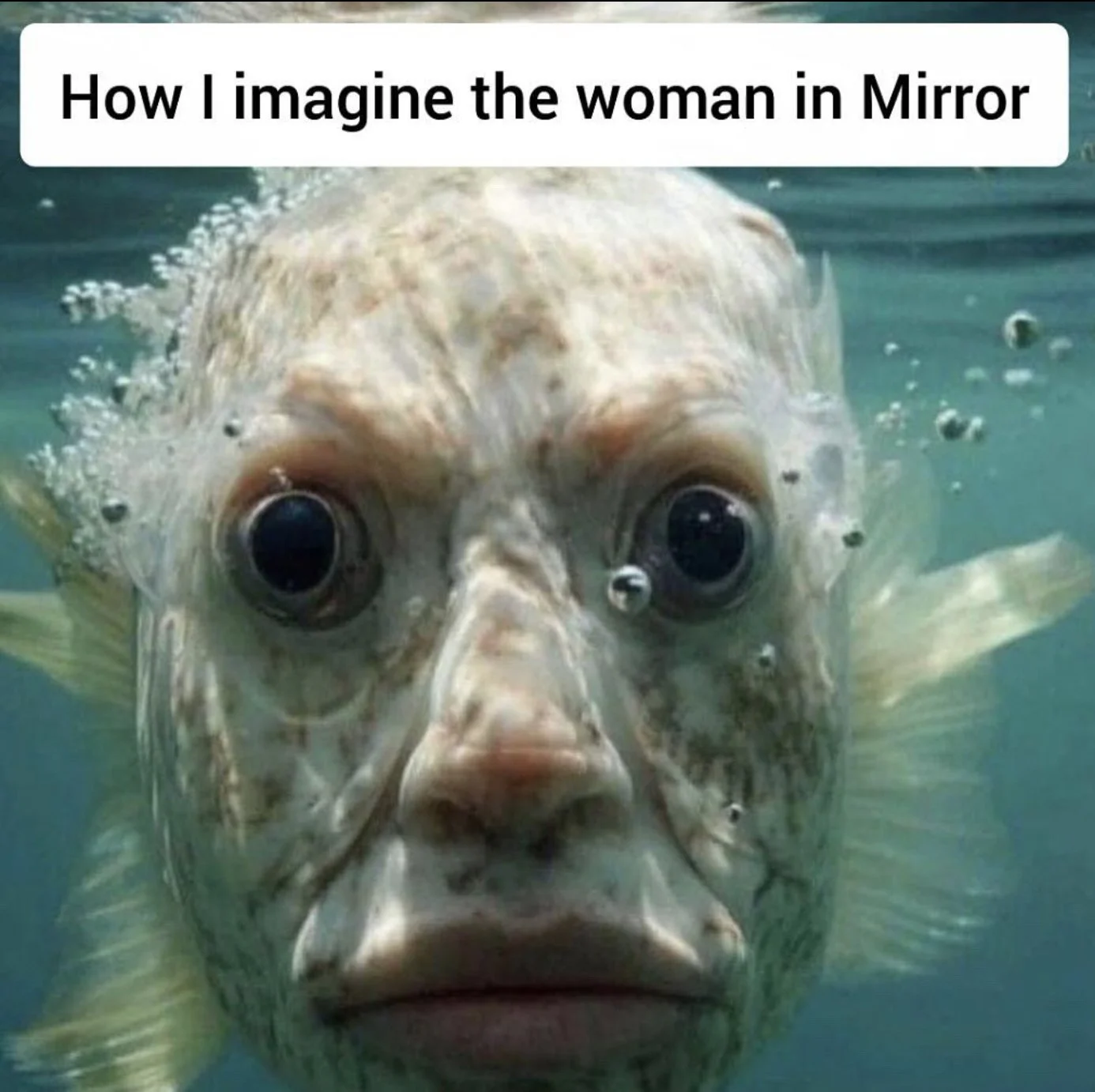
Rises toward her day after day, like a terrible fish.